
Ethical loneliness
On Renee Good, Palestine, and the uses of witnessing

Back in my days as an aidworker, I heard—and participated in—a lot of talk about the importance of witnessing. Often, the aid we were delivering was short-term or insufficient: a sack of maize meal in the middle of war, four sets of crutches for a camp teeming with disabled refugees, micro-loans of $20 amidst a collapsing economy. It was hard to feel like any of the goods we did or could deliver were adequate. But we could also bear witness. We could document, photograph, record. We could bring people’s suffering to the world’s attention, we could advocate, we could point out abuses and crimes. We could shatter the world’s indifference.
Doctors without Borders / MSF—still one of the best humanitarian organizations out there imo—was born from this idea of témoignage. In the early ‘70s, the French doctors Max Recamier and Bernard Kouchner, who were volunteering with the Red Cross during the Biafran War in Nigeria, grew increasingly horrified by the Red Cross’ refusal to speak on the atrocities its teams witness everyday: murders of civilians, deliberate starvation by blockading forces, sexual violence against Igbo women and children in particular. There was good reason for the organization’s silence: the Red Cross is often allowed into war zones where few other non-state actors are precisely because of their commitment to neutrality. But Recamier and Kouchner found this intolerable: they wanted to be part of an organization that both provided assistance in the direst of situations, and served as the world’s eyes and ears in that crisis. So they created such an organization. I remember reading a book about MSF’s founding and ethos just after college. I can’t remember the title but I know it had a blue cover and very tiny print. I read it one sitting. By the time I was done, I knew this was what I wanted to do with my life.
As I’ve written about before, one of my first jobs in aid was to document the deaths and injuries caused by explosive remnants of war (ERW) during the civil war in Mali that started in 2012 and never quite finished. The UN estimates that at least 10% of all ERW—bombs, grenades, missiles, mortals—fail to detonate immediately. In the aftermath, kids mistook the odd, shiny lumps for toys, and adults for scrap metal to be reused or resold. More often, the devices were concealed by dirt or debris—caved-in roofs, a felled tree trunk—and people didn’t see anything until a blast lifted them off their feet. In Mali, the UN had started clearing the ERW, but the north unspooled in an area larger than California and Nevada combined. Full clearance could take years. They were still clearing ERW from decades-old conflicts in Croatia, Cambodia, and Palestine. [In 2024, the UN estimated it would take at least 14 years to clear all the ERW from the latest bloody attacks on Palestine.]1
The NGO I worked for in Mali ran awareness campaigns to help people spot and avoid the literal death traps. “Public health, sort of,” was how I’d described it to my bewildered friends and mother. Everyday for almost a year, I used photos and notes collected by police, civilians, and our team of public health educators to piece together the stories of Malians killed or injured by ERW. These missives were then launched to our mailing list of American and European donors, coaxing their sympathy and money across the Atlantic.
I told myself this work was important not only for funding our activities, but also for creating an archive of the war’s impacts on the most intimate, individual level. Over time though, I found it hard to hang onto this belief. This work wasn’t changing anything—it wasn’t shortening the war, it wasn’t bringing international media attention to the suffering unfolding here. We didn’t even have solid data showing our awareness campaigns were working. Mali is after all a country of 25 million people, spread out over 480,000 square miles, nearly double the size of Texas and two-thirds as large as Alaska. Our team was made up of exactly eight people. The battle seemed lost before we even started.
Then one day a man came into our office in Bamako to report the death of his wife. Until then, I hadn’t had much direct contact with victims or their families. This young man rattled with energy, his thin chest quickening under a red Arsenals jersey. I offered him a chair, which he initially refused to pace the office, back and forth, back and forth. It was only as he began recounting for me the details of her life—her name, her age, her hometown, the ages of their kids—and death—she’d been walking back from the market in Kidal, a bag of tomatoes slung over shoulder—that his energy seemed to drain from him. He slumped in the chair, his gaze becoming unfocused. “So she will never cook those tomatoes,” he said, as if realizing it only now. She’d planned to make jollof rice for their daughter’s fourth birthday the next day. He’d been working in Bamako as a security guard and would take the long bus ride back home that night. He felt he had to do something while he waited, and the police had told him to come see us.
When I’d gathered all the information I needed for my report, he rose slowly from his chair. He hesitated, his lips opening and closing like a fish. Finally, he said, “Thank you for remembering her a little with me.” Then he set his glass of water down on my desk very gently and left.
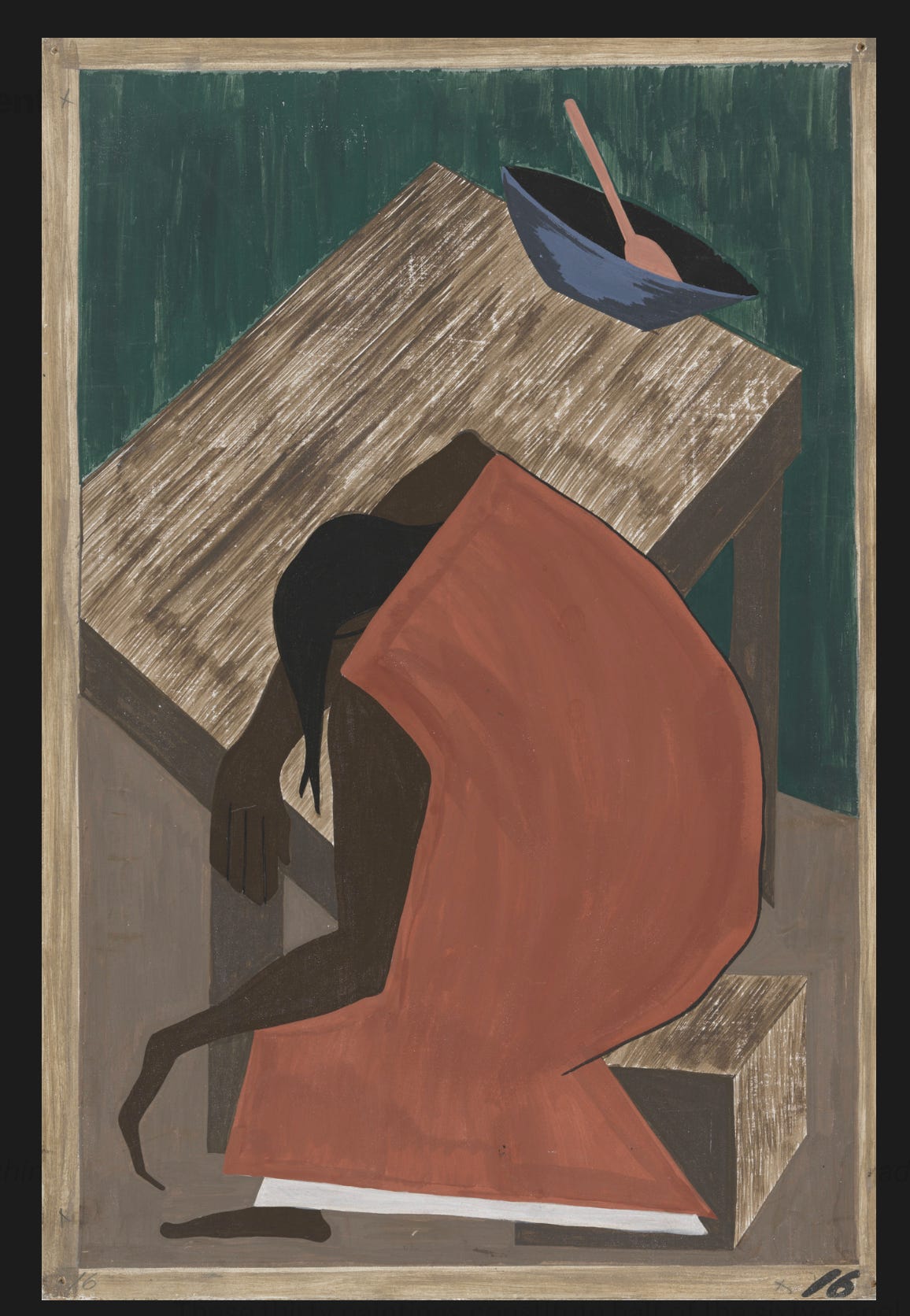
I’ve been reading the op-eds and hot takes about Renee Good with some wariness. Can’t the woman just rest in peace, I wondered. She did not ask to be turned into a symbol, just like she didn’t ask to be shot in the face. At the same time, I, like many of you, don’t want her death to be in vain. I want it to move us to action, to coalesce our sense of rage and horror into a movement, to infect us with a righteous fever that can only be cured by nationwide protests, shutdowns, and walkouts. And movements need figureheads after all. They need martyrs, even—and perhaps especially—unwilling ones.
Like many great things, it was the Black Panthers who originated the idea of a legal observer. Throughout the ‘60s, they organized armed patrols in Oakland to monitor police behavior. They called it "copwatch." Later the same decade, following large-scale anti-war and civil rights protests, the National Lawyers Guild established the nation’s first training program specifically for legal observers. Of course, no training is mandatory; anyone can practice their right to legally observe anytime they witness potential conflict between the public and law enforcement.
In serving as a legal observer, no matter how briefly or spontaneously, Renee Good was documenting the illegal disappearances carried out by ICE. This is important not only for eventual legal action against ICE (please god!) but also for alleviating what philosopher Jill Stauffer calls “ethical loneliness.”
“Ethical loneliness is the isolation one feels when one, as a violated person or as one member of a persecuted group, has been abandoned by humanity, or by those who have power over one’s life’s possibilities. It is a condition undergone by persons who have been unjustly treated and dehumanized by human beings and political structures, who emerge from that injustice only to find that the surrounding world will not listen to or cannot properly hear their testimony—their claims about what they suffered and about what is now owed them—on their own terms.”
In other words, ethical loneliness is the condition of being oppressed or dehumanized that is compounded by feeling unheard or unseen. It is the victim of sexual assault whose testimony is dismissed. It is the condition of Palestinians who’ve live-streamed their own genocide only for the world to look away or accuse them of anti-Semitism. It is when you’re not only undocumented—“an illegal alien”—but when your disappearance is not noticed, investigated, or protested by your neighbors, your employers, your community.
I've never come close to an ICE raid. But I know the worst moments of my life have not necessarily been when a terrible thing happened to me, but when I felt no one knew or cared or believed. It is the worst, most painful loneliness.
It is also precisely what makes punishments like solitary confinement in immigration detention—which have also jumped under the current administration2—so torturous. From studying prisoners in solitary confinement, philosopher Lisa Guenther concludes we need others to validate our experience of anything—a teapot, the smell of clothes fresh from the dryer, a sunset.3 Deprived of that, a person is sure to fall into hallucinations, memory loss and suicidal ideation. That is to say, deprived of social connection, we lose our grasp on reality. And isn’t it funny that that is exactly what this administration and its tech minions / overlords are trying to do? To scramble our sense of shared reality? To position a woman practicing her right to legally observe as engaging in terrorism? To claim that what we see and hear with our own eyes is false?
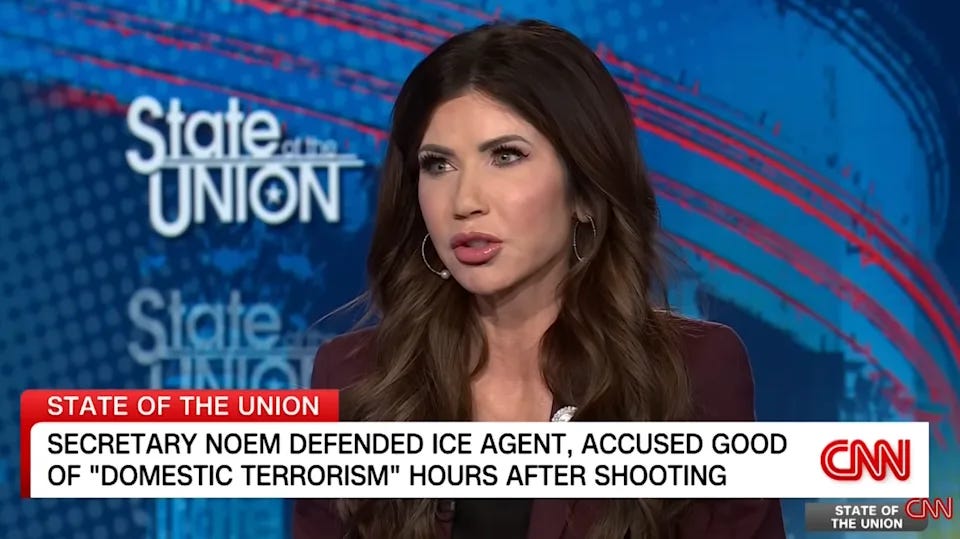
The good news—if there is any—is that people can overcome unspeakable things when they’re held and seen in their worst moments. We know from decades of research that having someone to process your trauma with can make a world of difference. That being believed and validated in your suffering can help ease that suffering. That for community to keep showing up for you when you can’t show up for yourself is the ultimate act of devotion, an insistence upon your humanity, and a balm not unlike love for your nervous system.
I am so moved by all the Minnesotans who continue to show up, who continue to exercise their legal rights to document and follow and protest and patrol schools and deliver groceries to their immigrant neighbors. Still, I have to be honest: I don’t know if Good’s murder will lead to significant change. I have seen some instances of ICE looking cowed by demonstrators. But for the most part, it seems to have amplified their sense of impunity. We keep seeing people kidnapped from their homes, their workplaces, their cars and somehow, unbelievably, the world goes on. It seems our indifference has not been shattered but only scratched.
But I do think and hope such witnessing will change things—even if only slightly—for the targets of enforcement. That it may not temper the principal injustice of what’s happening to them, but at least the secondary injustice of not being seen or heard, of not being witnessed in the violation of their legal rights. That even if the world forgets them, Renee Good and the thousands of others documenting the harm done to them did not, cannot, will not.
https://news.un.org/en/story/2024/04/1149051
https://www.icij.org/news/2025/09/solitary-confinement-in-ice-detention-spiked-during-early-months-of-the-trump-administration-report-finds/
https://www.thebeliever.net/an-interview-with-lisa-guenther/
Reading this after Alex Jeffrey Pretti was taken from us after legally observing an ICE raid, where subsequent action is being taken to hide evidence of the murder and turn the story of his death into another false “terrorist” narrative. the pattern they follow is repetitious and mind numbing. I’m hoping that the observing and empathizing carried out by all protesters will continue to grow and become even more unshakeable against the lies that the administration continue to tell. What a good piece! 🤍and I love the Lawrence painting too.
Thank you for writing.