
Say nothing
On surveillance and self-censorship in America

Over the past year, I’ve been reporting a feature story that explores law enforcement’s growing surveillance of our online lives. It’s not something I’ve reported on before, and as I wrap up final edits, I’m struck by how horribly timely it is, in ways I couldn’t have foreseen when I first pitched the story last spring. As journalist Violet Blue writes in WIRED:
Collaboration between Big Tech and the Trump administration began before Donald Trump’s swearing-in on January 20. Amazon, Meta, Google, Microsoft, and Uber each gave $1 million to Trump’s inauguration. Separately, in personal donations, so did Meta CEO Mark Zuckerberg and Apple’s Tim Cook.
Since then, DOGE has staged what some have called a “digital coup” of government. Not only can his team access historically protected data on millions of US residents from its vast databases, but also from its tech buddies. “This means the companies with the most insight into our lives, movements, and communications are frontline arbiters of our constitutional rights and the rights of non-US citizens—a fact some are likely feeling more acutely now than ever,” writes Blue.
Indeed. As a green card holder—technically, “a legal permanent resident”—I’ve felt the warm comfort of that identity shredded over the past months. I won’t recap the arrests and detentions of people who share this same identity of “legal permanent resident” over the past months. I’m sure you’ve heard about them. But you may not have heard yet that the Department of Homeland Security recently started requiring all immigrants—including legal workers, students, and green card holders—to carry their ID documents at all times. A neighborhood walk without your papers now carries the risk of … what? Arrest, detention, deportation? No one knows.
Before going further, I want to acknowledge that I’m still in a very privileged position compared to many immigrants, including the undocumented and those on temporary visas. They are the most vulnerable and the most targeted, and if I’m increasingly caught up in anxiety, I can only imagine the paralyzing fear that must follow them.
What unites us in this moment, I think, is a heightened state of self-censorship. I think twice about what I write, including this post, which I deliberated over for a long time before taking a deep breath and finally hitting “publish.” I’m nervous to sign or share petitions. I find myself hesitating before liking a post on Instagram or even here, on Substack, if said post criticizes the government or its strange bedfellows. I’m rethinking all my travel plans. I’m even scared to Google certain things, knowing that my search records could be turned over to the state. Legal experts call this reluctance to engage in First Amendment-protected activities, including the right to search out new ideas without consequence, a “chilling effect.” Maybe hell isn’t an inferno but an icefield.
The strange thing about living in a highly surveilled and punitive state: no one actually has to be surveilling you, you do it yourself. The French philosopher Michel Foucault compared it to living inside a “Panopticon,” a prison designed to keep inmates in the constant sightline of a guard. He can see them, but they can’t see him. Believing they’re always watched, even if that’s not actually the case, prisoners change their behavior, effectively policing themselves.
It’s embarrassing to admit, but for the first time in my life, I’m getting a taste of how people I thought I knew well and understood intimately actually experience life. I’m thinking of my queer, trans, and activist friends in Africa. Of the undocumented immigrants I’ve gotten to know through my reporting here in Colorado. Of the Bangladeshi woman without papers who used to clean and cook for us in India, and who I often thought of a second mother.
The truth is that I’ve always been protected—first, by dint of being upper-caste in south Asia, then by my Canadian passport, and most recently by my treasured green card. Only now in my mid-thirties am I seeing those pieces of paper might not protect me forever. That they could be burned at any moment like any other paper.
So, what’s left? Ironically, in a time when fear threatens to make me speechless, I find myself turning to words. How do we use language to say what cannot be said?
I keep remembering a conversation I had with an artist friend in Uganda about “unsayability,” specifically as it relates to homosexuality. “Gay” is a relatively modern concept in Uganda, brought over by British colonists and associated with “unnatural acts.” You can’t say “gay” in Uganda without risking arrest and even death. But of course gay and trans people have always existed there. And my friend is determined to tell those queer histories without using language that would be inflammatory in modern-day Uganda.
One of the terms she’s contemplating using comes from the Lango language, widely spoken in Uganda’s north. In Lango, “Mater perre” translates roughly to “the transparent man,” and refers to a trans or gay woman. I find the wording beautiful—a being who is transparent about their own desires. A being who’s long been around, accepted and even protected—and perhaps still would be if presented in terms that people are likely to honor as part of their own lineage, rather than regard as some foreign atrocity.
On that note, I’ve also been thinking about how we can speak about atrocity—real atrocity that is happening all around us. How can we subvert and reinvent our vocabulary?
One example can be found in the 1996 testimony of Notrose Konile before the South African Truth and Reconciliation Commission about the murder of her son. She narrated a dream about a goat. Initially dismissed as rambling, Mrs. Konile’s testimony gained both coherence and importance when interpreted through Xhosa storytelling traditions.
“To fully appreciate our [people’s] words you have to understand a whole history of fear, hiding, running, evading,” writes the South African team who insisted on interpreting her testimony.
Both code-switching and living with a certain level of fear is second nature to most immigrants in this country. It’s time we used them to our advantage to develop a new code.
I think, too, of poets, and erasure poetry, wherein words are removed from an existing text to create a new poem, surfacing meanings that were previously submerged. Is there a form more suited to communicating the unsayable and the subterranean? Consider, for example, Tracy K. Smith's powerful erasure of the Declaration of Independence:
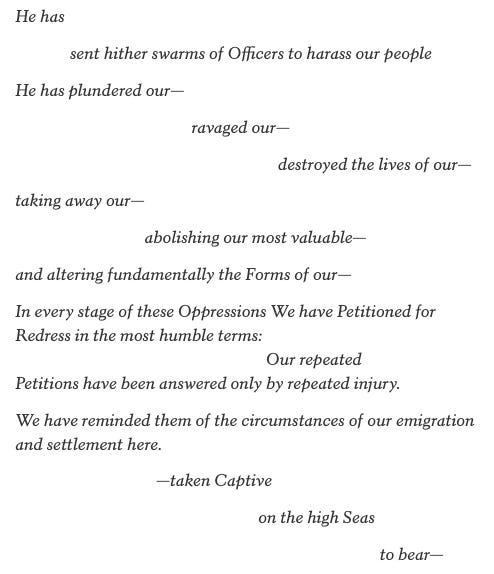
There’s more to be said—and in more creative ways than what I currently know—but for now, I’ll end here. For noncitizens worried about their rights while traveling, this free workshop on April 17 might be of interest.
Thank you, as always, for reading.
-Raksha
P.S. There’s still a few spots in my travel writing class this Saturday. We’ll study the work of mostly immigrant writers, how they use language with great sensitivity to guide readers into new places. Scholarships are available, and you can join virtually from anywhere.
So grateful for your voice, Raksha. I have little comfort to add, beyond that which comes from knowing someone is reading and taking your words to heart.
This is chilling. I'm not sure what else to say, except thanks for writing it 💕